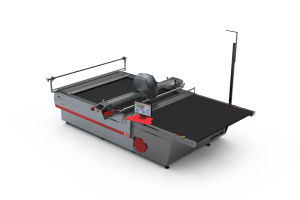
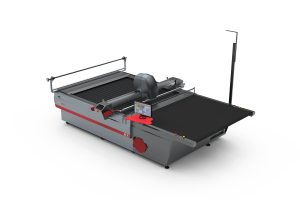
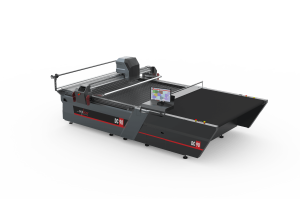
A straight knife cutter (the hand-guided “cutting motor” of the cutting room) is a low-investment tool the operator pushes along the lay by hand; it is enough for a few lays a day, simple pieces and low ply counts. Automatic CNC cutting cuts a vacuum-compressed lay from the marker file in the computer with ±0.5 mm accuracy; the cutting allowance drops to zero, the result no longer depends on the operator, and the investment pays back as the number of lays per day grows.
The decision hangs on three questions: how many lays a day do you cut, how complex are the pieces, and what does waste cost you. In this article we compare the two on 10 criteria and recommend by business profile.
What Is a Straight Knife Cutter?
The hand-guided machine most cutting rooms simply call the “cutting motor” is technically a straight knife cutting machine. A straight blade driven up and down by an electric motor glides over the lay on a base plate; the operator pushes the machine along the lines of the paper marker laid on the fabric lay. Blade length is typically 13–33 cm (5–13 in); in practice no more than about two-thirds of the blade height is cut, so 10–20 cm of lay. Straight and wavy blades, a built-in sharpener and a blade guard are standard. For small and fine pieces most cutting rooms rough-cut with the straight knife and finish the pieces on a band knife.
How Is Automatic CNC Cutting Different?
In a CNC cutting machine the lay is compressed by vacuum on a perforated table (compressed cutting height 3–9 cm on Serkon models) and the marker goes to the machine from the CAD file instead of paper. A reciprocating blade follows the line on servo axes with ±0.5 mm accuracy; the blade angle is corrected automatically against deflection and sharpening is automatic. Cutting speed is 80–120 m/min depending on the model. The operator loads the lay and removes the cut pieces; the machine reports time, material and efficiency. For the working principle see how a CNC fabric cutter works.
Comparison on 10 Criteria
| Criterion | Straight knife | Automatic CNC cutting |
|---|---|---|
| Investment | ✓ Low | ✗ High |
| Accuracy | ✗ Operator-dependent, 3–5 mm allowance | ✓ ±0.5 mm, zero allowance |
| Waste | ✗ Allowance + re-cutting | ✓ Edge-to-edge nesting, no allowance |
| Lay height | ✓ 10–20 cm (with ply-shift risk) | ~ 3–9 cm compressed, no shift |
| Speed / capacity | ~ Operator-dependent, long per lay | ✓ 80–120 m/min, continuous |
| Piece complexity | ✗ Small pieces, notches, sharp corners difficult | ✓ Any geometry |
| Operator dependence | ✗ Needs a skilled cutter | ✓ 1 operator, short training |
| Safety | ✗ Exposed blade, hand close by | ✓ Enclosed cutting area |
| Fabric range | ✓ Almost any fabric | ✓ Knit, woven, denim, technical (by model) |
| Data / reporting | ✗ None | ✓ Time, material, efficiency |
How Big Is the Waste Difference?
According to Serkon’s cutting measurements, 1 mm of allowance around a piece means at least 1% in material cost. In a cutting room working with straight knives, a 3–5 mm safety allowance means another 3–5% of the fabric is lost in the marker; re-cuts come on top.
For the other loss points see how to reduce fabric waste in the cutting room.
Which Suits Which Cutting Room?
Decide in 3 Questions
1–3 → a straight knife may be enough. 4–10 → the CNC investment pays back. 10+ → continuous cutting.
Many small pieces, notches and sharp corners, or small patterns such as childrenswear and underwear, inflate the straight knife’s allowance and re-cut rate → CNC.
Monthly fabric metres × 3–5% × fabric price = annual waste value. If that figure covers the investment in 2–3 years, the decision is clear.
5 Points When Moving from Straight Knife to CNC
- →The marker must be digital: a plan prepared in CAD goes straight to the machine; the paper marker is gone.
- →Spreading quality: CNC needs a well-spread lay; ply shift and tension differences show up in cutting. Choosing a spreading machine starts here.
- →Table and transfer: plan from the start how the lay reaches the cutter; the spreading table (air-floating or conveyor) is the key to this step.
- →Compressed height: the 15 cm lay you are used to on the straight knife becomes a 3–9 cm compressed lay on CNC; ply count is re-set by fabric.
- →Operator training: a machine operator instead of a master cutter; training takes a few days and machine reports make the process visible.
4 Common Mistakes
- Cutting lays that are too high with a straight knife. Ply shift grows, allowance and re-cuts increase, the blade heats up.
- Thinking of CNC with a paper marker. CNC’s gain comes from the CAD marker; bought without digitising, the machine runs below capacity.
- Choosing the machine by lay height. What decides is the number of lays per day and the fabric type; the “highest cut” is not always the right machine.
- Neglecting safety on the straight knife. Without a chain-mail glove, blade guard and training, the cheapest machine becomes the most expensive accident.
Conclusion
The straight knife is the right tool for a workshop with few lays and simple pieces; CNC cutting is the right machine once the number of lays per day and the cost of waste grow. The threshold between them is not a lay-height figure but the number of lays cut per day and the fabric lost as allowance. Share your numbers and let’s calculate together which capacity pays back.
Let’s Calculate Your Capacity Together
Share your lays per day, fabric type and monthly metres; we will show which of the MC, DC or DCC series pays back its investment, and how fast.
✉ Request a Quote Cutting MachinesFrequently Asked Questions
What is a straight knife cutting machine?
How many plies can a straight knife cut?
How much more accurate is CNC cutting than a straight knife?
Does a small workshop need CNC cutting?
What is the cutting height of a CNC cutting machine?
What is the first step when moving from straight knife to CNC?
Manufacturer of fabric spreading, cutting and inspection machines · Istanbul · 25+ years · exports to 80+ countries. October 2026.