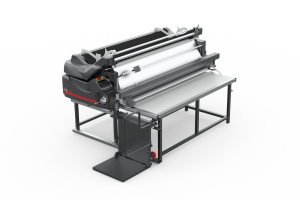
Tension-free spreading means releasing the winding tension a fabric carries on the roll during spreading, so each ply is laid on the table at its natural length, without being stretched. If elastane or knitted fabric is spread under tension, the cut part relaxes and shrinks afterwards: typically 1-3%, more on high-elastane fabrics. The result is parts smaller than the pattern, mixed sizes and recutting.
This article explains where the tension comes from, which fabrics are critical, how tension-free spreading is achieved in 4 steps and how to measure it.
Where Does the Tension Come From?
Fabric picks up tension in three places before it reaches the spreading table:
What Does Tensioned Spreading Do After Cutting?
The mechanism works in four steps; the tension is locked inside the lay and shows up once the part is freed:
Which Fabrics Are Critical?
The risk is set by elastane content and fabric construction:
| Fabric | Elastane | Shrinkage risk | Note |
|---|---|---|---|
| High-elastane knits (leggings, sportswear, swimwear) | 8-20% | Very high | Relaxation essential, 24 hours or more |
| Elastane single jersey / interlock | 3-8% | High | Relaxing and tension control together |
| Tubular knits | 0-5% | Medium-high | Two layers wound together, tension doubles |
| Knits without elastane (jersey, rib, interlock) | — | Medium | The knit structure itself stretches |
| Stretch wovens (stretch gabardine, stretch denim) | 2-3% | Medium | Shrinks across the width, little in length |
| Rigid wovens, denim, home textiles | — | Low | Little shrinkage; the issues are handling and edge alignment |
How to Achieve Tension-Free Spreading: 4 Steps
Unrolling the fabric and leaving it to rest (12-24 hours, 24 hours or more for high-elastane fabric) is the simplest route, but it costs floor space and time. A fabric shaking machine converts the roll into a relaxed, loose-fold state and removes the winding tension before spreading; the fabric can go straight into the lay without waiting. If the inspection machine can deliver a loose-fold output, relaxation merges into the quality-control step and stops being a separate operation.
On an automatic spreading machine the fabric is unrolled by a separate feed system, not pulled open by the carriage movement. An electronic dancer bar continuously measures the tension on the fabric and an encoder corrects the feed speed to the carriage speed in real time. The fabric arrives on the table released, not pulled; the tension stays the same at the start and the end of the roll. This is the single most critical criterion when choosing a spreading machine.
A roll hung on a shaft turns under its own weight, and the tension changes as the weight drops. In a cradle feed system the roll rests on a driven belt; whatever its weight, it does not generate tension through its own inertia. On heavy denim rolls (up to 350 kg) the difference is even more pronounced.
After the ply end is cut, the fabric is not clamped; it is left in its natural state. On elastane fabric the lay height is kept low, because the bottom plies stay locked longer under the weight of the plies above. Letting the finished lay rest on the table for 15-30 minutes before cutting allows the remaining tension to come out before the blade does.
Manual vs Automatic Spreading: The Tension Difference
| Manual spreading | Automatic spreading (tension-controlled) | |
|---|---|---|
| Source of tension | The operator’s pulling force | Feed system, measured by the dancer bar |
| Consistency | Varies by ply and by person | The same on every ply |
| Start / end of roll | Different | No difference (encoder corrects) |
| Effect of roll weight | Heavy rolls unroll under tension | None with cradle feed |
| Ply end | Cut by hand, allowance left | Cutting unit, 1-2 cm allowance |
| Measurability | None | Speed, tension and ply count recorded |
| Operators | 2-3 people | 1 person |
How Do You Know the Lay Is Tension-Free?
4 Common Mistakes
- Skipping relaxation to save time. The hour saved comes back as days of recutting.
- One recipe regardless of elastane content. Plain jersey and a 15% elastane swimwear fabric are not spread with the same settings.
- Hanging the roll on a shaft and letting its weight unroll it. The start and the end of the roll are spread at different tensions.
- Enlarging the pattern to compensate for tension. Shrinkage varies by fabric and by roll, so a fixed allowance never fits; the cause has to be removed.
Conclusion
On elastane and stretch fabrics, dimensional consistency is won or lost in spreading, not on the cutting table. When relaxation, synchronised feed, correct roll loading and ply discipline are applied together, shrinkage drops below 0.5%; recutting and mixed sizes disappear.
Let’s Run a Spreading Test With Your Fabric
Send us your elastane or knitted fabric; we will measure post-spreading shrinkage with relaxation and tension control together, and propose the spreading set-up that suits your line.
✉ Get a Quote View Spreading MachinesFrequently Asked Questions
What is tension-free spreading?
How much does elastane fabric shrink after spreading?
How long should fabric relax before spreading?
What does a fabric shaking machine do?
What is a dancer bar on a spreading machine?
How can you tell the fabric was spread under tension?
Manufacturer of fabric spreading, cutting and inspection machines · Istanbul · 25+ years · exports to 80+ countries. September 2026.