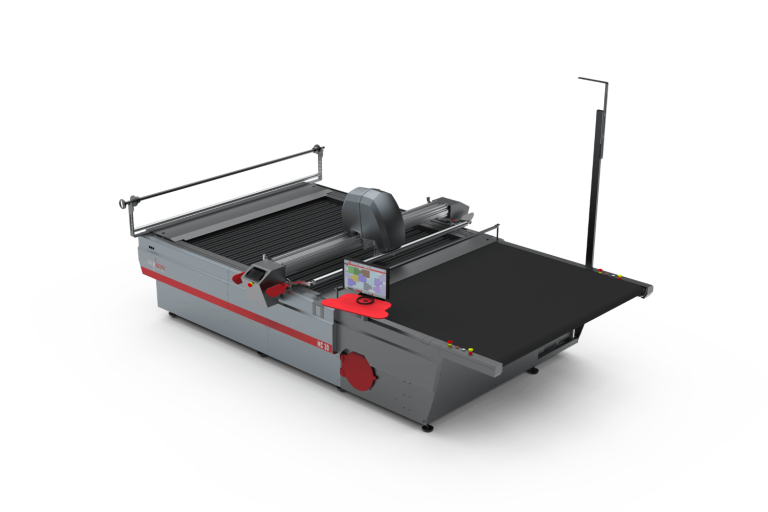
A fabric cutting machine (CNC cutter) compresses the spread lay under vacuum and then cuts the marker coming from CAD with a servo-driven blade, separating it automatically into parts. It works in four steps: the marker is loaded, the lay is vacuum-compressed, the blade follows the cutting path, and the blade sharpens itself automatically as it cuts.
The cutter is the machine that takes over after spreading in the cutting room. Once the fabric has been laid in stacked plies (a lay), the cutter cuts that lay as a single block. In manual cutting, every ply depends on the operator’s hand-held blade and eye; in automatic cutting the cutting path comes from the computer, and the machine cuts the same pattern to the same precision every time.
That gives the cutting room two fundamental gains: dimensional consistency (every part matches the pattern exactly) and waste control (nesting is optimised in software). A cutter cannot compensate for poor spreading, which is why spreading and cutting must be planned together. For the selection criteria on the spreading side, see our article How to Choose a Fabric Spreading Machine.
Automatic cutting on a vacuum-compressed lay: Serkon DC90
How Does a CNC Cutter Work? Step by Step
1
The marker is loaded from softwareCutting starts with a marker in which the pattern pieces are nested across the fabric width. Serkon cutters are compatible with any CAD system; the plan is transferred to the machine and the cutting path is set. A Windows-based All-in-One PC and multi-language support let the operator view the plan on the machine itself.
2
The lay is transferred to the cutting tableThe finished lay is moved onto the cutting conveyor. It is critical that the lay sits square and without skew — any slippage puts every ply out of size. Serkon machines use laser lay-skew detection to catch this error before cutting begins.
3
Vacuum compresses the layThe most decisive component of a cutter is its vacuum system. Air drawn through the table surface compresses the lay into a single block; the plies lock together and cannot shift as the blade advances. If the vacuum is too weak, a size difference appears between the top and bottom plies — the problem the industry calls “top-to-bottom deviation”. Serkon vacuum power is 18 kW on the DC90 and 30 kW on the DCC80, and it is parametrically adjustable.
4
The servo-driven blade does the cuttingCutting is performed by servo motors working on four axes (X, Y, Z, C). X and Y control the blade position on the table, Z its vertical movement and C its rotation angle — so corners and curves follow the pattern exactly. On the DC90 the Z-axis motor speed is 6,000 rpm. Maximum cutting speed depending on model is 80–100 m/min, cutting width 160–220 cm and the cutting window 180 cm.
5
The blade is sharpened and monitored automaticallyA blunt blade spoils the cut edge and makes the fabric pull. Cutters therefore have an automatic sharpening system: the blade sharpens itself at set intervals during cutting. Blade monitoring with automatic stop halts the machine if a problem occurs, preventing a faulty cut from continuing.
6
The cut is reported and the line moves onWhen cutting is complete the machine produces graphical output through its smart reporting system (lay cut, time, efficiency). The hibernate function on the DC90 lets an interrupted lay be resumed where it left off. The Zero Buffer cutting function cuts without leaving gaps between pattern pieces, raising fabric utilisation.
4 Technical Factors Behind Cutting Quality
The real performance of a cutter is not defined by a single figure but by four factors working together:
1
Vacuum power
Locks the plies together and prevents top-to-bottom deviation. 18 kW (DC90) – 30 kW (DCC80), parametrically adjustable.
2
Cutting height
The compressed lay thickness that can be cut in one pass. 3 cm (MC30) – 9 cm (DC90).
Catches dimensional errors before cutting starts. CAD compatibility, laser skew detection, blade monitoring, Zero Buffer.
🔎 Reading the model names: The number in a Serkon model name is the cutting height (cm) under vacuum compression. MC30 = 3 cm · DCC80 = 8 cm · DC90 = 9 cm.
Which Cutter Suits Which Operation?
The right machine follows from your production volume, fabric type and the lay thickness you work with. The Serkon cutting range falls into three main series:
High-volume lines running without interruption; woven, denim, workwear
Each series contains models at different cutting heights (MC30/50/70, DC70/80/90, DCC70/80/90). The speed-focused FMC30 Fast Master Cut also sits in the range. You can see every model in the automatic cutting machines category.
Decide by question, not by scale
1
How thick is the lay you cut?
3 cm under compression, or 9 cm? That alone determines the series.
2
Does your line stop, or run continuously?
If you cut without interruption through the shift, you need the DCC series and high vacuum.
3
What is your main fabric?
Heavy fabrics such as denim and workwear demand high vacuum and a strong blade.
4
Is your power supply sufficient?
The MC30 consumes 9–12 kW on average and the DC90 14–16 kW; the vacuum needs a further 15–30 kW of installed power.
Checklist Before Moving to Automatic Cutting
1
Is your spreading side ready?A cutter cannot correct a badly spread lay. Spreading and cutting must be planned together.
2
Is your CAD system compatible?The data flow between your existing pattern software and the machine should be tested in advance.
3
Layout and infrastructureCutting width (160–220 cm), machine footprint, installed electrical power and the location of the vacuum unit all need planning from the start.
4
Ambient conditionsCutters are designed to run at 10–40 °C ambient temperature; noise level on the DC90 is below 80 dBA.
5
A test with your own fabricAsk for a cutting test with your own lay before deciding — catalogue figures describe general conditions.
⚠ 3 Common Mistakes
Looking only at cutting speed. 100 m/min means producing faulty parts faster if the vacuum and blade are not up to it.
Assuming a higher cutting height than you actually get. The stated figures are heights under vacuum compression — not the loose lay thickness.
Leaving spreading and handling out of the calculation. A cutter is not a solution on its own; it is one link in the spreading–cutting–handling chain.
25+years of experience
80+export countries
21,000 m²production facility
750+customers
Let’s Choose the Right Cutter for Your Cutting Room
Tell us your fabric type, lay thickness and production volume; we will provide a free assessment and quotation for the right cutting machine and line layout.
Cutting height varies by model and is measured under vacuum compression. In the Serkon range the MC30 cuts 3 cm, the DCC80 8 cm and the DC90 9 cm. The number in the model name gives this figure.
What is the difference between a CNC cutter and manual cutting?
In manual cutting the path depends on the operator’s hand-held blade, so the result can vary from lay to lay. On a CNC cutter the path comes from CAD and the machine cuts the same pattern to the same precision every time. Dimensional consistency and nesting optimisation are what set them apart.
Why does vacuum matter so much on a cutting machine?
Vacuum compresses the plies and locks them together. With insufficient vacuum the plies shift as the blade advances and a size difference appears between the top and bottom plies. Vacuum power on Serkon models ranges from 18 to 30 kW and is parametrically adjustable to the fabric type.
Which fabrics does an automatic cutting machine work with?
There are models for woven fabrics, denim, workwear, synthetic fibre, non-woven, technical textiles and composite materials. Series selection follows your main fabric group and the lay thickness you work with.
Will the cutter work with my CAD system?
Serkon automatic cutting machines are compatible with any CAD system. Even so, we recommend testing the data flow with your existing pattern software before installation.
S
Serkon Makina Technical Team
We have been manufacturing fabric spreading, cutting and quality control machines since 2000. A 21,000 m² production facility, an R&D centre and exports to more than 80 countries.